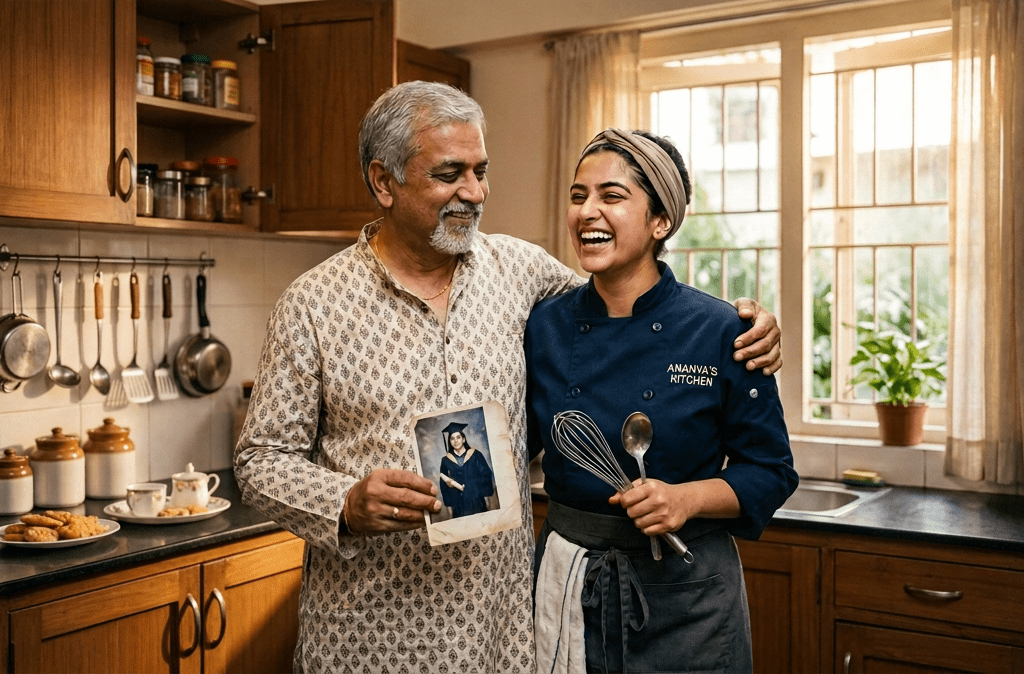
Dev had wanted a daughter long before he knew what it meant to become a father.
Whenever relatives spoke of sons carrying forward the family name, he would smile and say, “A name can be carried forward by anyone. I want a little girl who will fill my home with stories.”
After five years of marriage, when the nurse finally placed a tiny, tightly wrapped bundle in his arms, Dev stared at her as though the universe had entrusted him with its most precious secret.
“She has your eyes,” his wife, Naina, whispered weakly from the hospital bed.
Dev shook his head.
“No. Her eyes are far more beautiful.”
The baby opened them briefly, stretched out one small hand and curled her fingers around his thumb.
That was all it took.
Dev’s heart—until then occupied by practical things like salaries, savings and monthly expenses—surrendered completely.
“What shall we name her?” Naina asked.
“Paridhi,” he replied. “The horizon—the boundary that holds an entire world within it.”
Then he looked down at his daughter. “But for me, she will always be Pari.”
From that day onward, Dev’s world began and ended with her.
Every evening, after returning from his job as a senior accountant in a government organization, he would place his office bag by the door and ask loudly, “Where is Papa’s Pari?”
Even before she had learned to walk properly, Pari would totter towards him with her arms raised.
His tiredness disappeared the moment she laughed.
He bought her dolls that blinked, stuffed animals larger than she was, puzzles she was too young to solve and dresses for occasions that did not yet exist.
“You know she cannot possibly wear all these before she outgrows them,” Naina would remind him.
Dev would hold up another tiny dress and say, “But look at it. It was clearly waiting for Pari.”
Naina would shake her head, pretending to disapprove while quietly making space in their daughter’s already overflowing cupboard.
When the time came for Pari to begin school, Dev chose one of the best schools in the city. Naina studied the fee structure and looked at him anxiously.
“Dev, this is far beyond what we had planned. There are other good schools.”
“I know.”
“The fees will increase every year. There will be books, uniforms, activities and transport.”
“I know that too.”
“Then?”
Dev looked towards the bedroom, where four-year-old Pari was explaining the alphabet to her dolls.
“We will reduce something else,” he said. “But we will not reduce her opportunities.”
Numbers had always made sense to Dev. He understood balance sheets, budgets and exactly how much the family could—or could not—afford.
So he created room where none existed. After completing a full day at the office, he began teaching mathematics and accounting at a coaching institute in the evenings. By the time he returned home, Pari was often already asleep.
On those nights, he would sit beside her, move the hair away from her face and whisper, “Papa is here.”
Sometimes her eyes would remain closed, but her little fingers would search for his hand.
That was enough to make the exhaustion worthwhile.
Every birthday became a celebration grander than the previous one. The cake came from the best bakery in the city. The decorations matched whichever character Pari loved that year, and her presents included nearly everything she had mentioned in the preceding months.
“Papa, you remember everything,” she said once, opening a dollhouse she had admired weeks earlier.
“Of course,” Dev replied. “I’m an accountant. I maintain very detailed records.”
But life does not always respect the plans we make so carefully.
When Pari was eight, Naina developed a persistent cough. What first appeared to be a stubborn infection became a succession of tests, hospital visits and whispered conversations outside closed doors.
The diagnosis was late-stage lung cancer.
Within six months, Naina was gone.
On the day of the funeral, people filled the house. Some wept, some offered advice and others discussed Dev’s future as though he were not sitting in the same room.
“He is still young.”
“A child needs a mother.”
“He cannot manage everything alone.”
Dev heard them all.
That night, after everyone had left, he found Pari sitting on the floor beside Naina’s cupboard, holding one of her mother’s dupattas against her face.
“Papa,” she asked, “who will make my lunch for school now?”
It was not the question of a child worried about food. It was the question of a frightened little girl asking what else in her life was about to disappear.
Dev sat beside her.
“I will.”
Pari looked at him doubtfully.
“But you don’t know how to cook.”
“That is a minor technical issue.”
“Mumma said you once burnt boiled eggs.”
“She exaggerated.”
“She said the water dried up and the eggs exploded.”
Dev paused.
“Fine. That may have happened once.”
For the first time in days, a faint smile appeared on Pari’s face.
Dev took her hand.
“I don’t know how to do everything Mumma did, Pari. But I can learn. And whatever happens, I am not going anywhere.”
Several relatives suggested that he remarry. They meant well, but Dev could not bring himself to introduce another person into Pari’s life simply because the world believed a man could not raise a daughter alone.
Pari did need a mother.
But no one could replace the one she had lost.
So Dev chose instead to become whatever else she needed.
His first rotis were neither round nor completely cooked.
Pari stared at the shapeless creation on her plate.
“Papa, what is this?”
“A roti.”
“Are you sure?”
“Reasonably.”
She lifted it and examined its uneven edges.
“Mumma’s rotis were round.”
Dev’s smile faltered for just a moment.
“I know.”
Pari tore off a small piece and tasted it.
“This one looks like a map.”
Dev leaned closer.
“Of India?”
“No. A country nobody has discovered yet.”
“Then you should feel honored. It has been named after you.”
Pari took another bite and nodded solemnly.
“Pariland tastes okay.”
That night, after she fell asleep, Dev returned to the kitchen. He watched another cooking lesson and practiced rolling circles until nearly midnight.
He learned how to pack lunches, remove stains from uniforms and separate white clothes from colored ones. He learned that braiding hair required far more skill than preparing financial statements and that two matching ribbons could disappear even when no one had touched them.
“Papa, this braid is higher than the other one,” Pari complained one morning.
Dev tilted his head to study his work.
“That is intentional. It’s a new style.”
“I look crooked.”
“Fashion is often misunderstood in its own time.”
Pari laughed, pulled out both hair ties and showed him how to begin again.
Dev converted his evening classes into online sessions so he could be home when she returned from school. He cooked between lessons, helped with homework after dinner and stayed awake completing his office work once she had gone to sleep.
His sacrifices rarely announced themselves.
When his shoes wore thin, he had them repaired.
When his scooter began breaking down, he learned which sound could be ignored and which one required a mechanic.
He wore the same few shirts until the collars faded.
One afternoon, he and Pari went shopping because he genuinely needed a new shirt. Before they entered the menswear store, Pari stopped in front of another window.
“Papa, look at that dress!”
The blue dress on the mannequin shimmered beneath the display lights.
“You already have an entire cupboard full of dresses,” Dev reminded her.
“But none exactly like this one.”
“That is a very strong argument.”
“Can I try it? Just try it?”
Dev looked at the price tag and then at the shirt sale advertised in the store beside them.
That evening, Pari returned home holding the blue dress against her chest.
Dev returned wearing the same pale shirt he had owned for years.
She never knew that the money he had kept aside for himself had paid for it.
He did not tell her.
Fathers rarely maintain accounts of what they give their children.
When Pari approached thirteen, Dev faced a responsibility that made even this otherwise confident man nervous.
He read articles about puberty, spoke with a doctor, studied menstrual health and stood helplessly in the personal-care aisle of a pharmacy until a woman behind the counter took pity on him.
A few days before Pari’s birthday, he placed a small packet beside her on the dining table.
“What is this?” she asked.
Dev sat across from her.
“Pari, you’re growing up. Your body will begin to change, and one of those changes will be your periods.”
Her eyes widened. “Papa!”
“What?”
“You’re talking about…that?”
“Yes.”
“But who taught you?”
“Doctors, books, your science textbook, the internet and one extremely patient lady at the pharmacy.”
Despite her embarrassment, Pari giggled. “You asked the pharmacy aunty?”
“I had to. There were too many choices. Some had wings, but not the kind of wings I expected.”
“Papa!”
Dev smiled, relieved that she was laughing.
Then his voice softened.
“Listen to me, Pari. There is nothing dirty or shameful about any of this. If it happens at school, if you feel unwell or if you need anything, you call me. You never have to hide it from me.”
She looked at the packet and then at him.
“You won’t feel embarrassed buying these?”
“I may spend twenty minutes staring helplessly at the shelf,” he admitted, “but I will never feel embarrassed about taking care of my daughter.”
A few weeks later, Pari returned from school bursting with excitement.
“Papa, do you know what happened today?”
Dev looked up from his laptop.
“You received another surprise test?”
“No. A girl in my class got her first period. She was scared and didn’t know what was happening. I gave her the pad you had put in my schoolbag and took her to our teacher.”
Dev closed his laptop.
“You handled everything yourself?”
Pari nodded proudly.
“Everyone said I knew the most about it.”
“Well, your science teacher must be very good.”
“I told them my papa taught me.”
Dev’s fingers stilled above the keyboard.
“And what did they say?”
“They said I’m lucky.”
He looked at the girl sitting before him—confident, compassionate and unashamed.
“No, Pari,” he said quietly. “I’m the lucky one.”
Years passed.
Pari studied hard and scored ninety-five percent in her Class XII examinations. Relatives immediately began recommending engineering, medicine, finance and government service.
Pari wanted none of them.
One evening, she sat beside Dev with unusual seriousness.
“Papa, I need to tell you something.”
Dev put down the newspaper.
“That sentence is never followed by anything inexpensive.”
“I don’t want to become an engineer or a doctor.”
“That part I already know.”
“I want to become a chef.”
Dev watched her carefully. “A chef?”
“I know people may not consider it a proper career. But when I’m cooking, I feel…” She searched for the right words. “I feel like I’m creating something that can become part of someone’s memory.”
Dev remembered the little girl who had named his misshapen roti Pariland.
“Then we should find out where the best culinary colleges are.”
Pari blinked. “You’re not upset?”
“Should I be?”
“I scored ninety-five percent.”
“Your marks prove that you can work hard. They do not get to decide what you must love.”
He accompanied her to colleges, spoke with faculty members and studied placement records as carefully as he had once studied her school fees.
The course was expensive.
So, Dev increased his tuition hours, withdrew part of his provident fund and applied for an education loan. He postponed replacing the scooter again.
Pari received admission to one of the finest culinary institutes in the country.
The college was in another city.
On the morning of her departure, Dev checked her luggage repeatedly.
“Documents?”
“Yes.”
“Medicines?”
“Yes.”
“Emergency money?”
“Yes, Papa.”
“Phone charger?”
Pari held it up. “Would you also like to check whether I have packed myself?”
Dev tried to smile.
At the railway station, he carried her suitcase until the attendant took it from him.
“Eat on time,” he instructed.
“I’m going to culinary college.”
“That does not guarantee that you will remember to eat.”
“And you take care of yourself.”
“I always do.”
They both knew that was not entirely true.
When the train began to move, Pari leaned out slightly.
“Bye, Papa!”
Dev raised his hand.
“Bye, Pari.”
He stood there until the last compartment disappeared.
When he returned home, the silence felt larger than the rooms.
At first, Pari called every day. She told him about her teachers, kitchen burns, impossible recipes and classmates from different parts of the country.
Then the calls became alternate-day conversations.
Then weekly ones.
Sometimes she called while hurrying between classes.
“Papa, I’ll speak properly on Sunday.”
“Of course. Go, you’ll be late.”
On Sunday, if she forgot, Dev never complained.
He would type, Everything all right?
When she replied, Yes, Papa. Just very busy, he would write, Good. Work hard.
Then he would put the phone beside him and continue waiting for it to ring.
Pari excelled in her course and secured a placement in the kitchen of a five-star hotel, working under a renowned chef.
When she called with the news, Dev’s voice carried more excitement than hers.
“I told you!” he said. “Ninety-five percent does not belong only in engineering colleges.”
A few years later, the hotel sent Pari overseas for an important assignment. It was the kind of opportunity she had dreamed of—working in an international kitchen, learning from celebrated chefs and proving herself in an unfamiliar world.
Dev was immensely proud of her.
He also counted the days until she would return.
As Diwali approached, Pari called him.
“Papa, I’m coming home.”
Dev’s face lit up. “When?”
She gave him her flight details.
“And,” she added, trying to sound casual, “I’m bringing someone with me. There’s someone I want you to meet.”
Dev became silent for a moment.
“Someone?”
“Yes, Papa.”
“A colleague?”
“Yes.”
“Only a colleague?”
Pari smiled into the phone. “You can conduct the full investigation when we get home.”
Dev understood immediately.
Fathers spend years knowing that such a day will arrive and quietly hoping that time might forget to bring it.
On the day of the flight, Pari and Dhruv landed forty-five minutes earlier than scheduled.
As they collected their luggage, Dhruv checked his phone.
“Since we’re early, your father probably hasn’t left home yet,” he said. “We can take a cab from the airport and surprise him.”
Pari looked at him and smiled. Dhruv still had a great deal to learn about her father.
The automatic doors opened into the Arrivals hall.
And there he was.
Dev stood beyond the barrier with an enormous bouquet in his hands—far too large for the occasion and exactly the size Pari had expected. His eyes moved impatiently across every face emerging through the doors.
The moment he saw her, his entire face transformed.
He raised one hand and began waving so vigorously that several people around him turned to look.
“Pari!”
Before she could reach him, Dev had already started moving towards her, navigating around waiting families and luggage trolleys with the urgency of a man who had waited far too long.
Pari abandoned her suitcase and ran to him.
Dev wrapped his arms around her, still clutching the bouquet awkwardly between them. He did not seem to remember that they were standing in a crowded airport, that strangers were watching or that Pari had arrived with someone he was supposed to meet.
For that moment, he saw only his daughter.
“My Pari is home,” he said, holding her as though she had returned after years rather than months.
Pari laughed against his shoulder, her eyes filling with tears.
“I missed you too, Papa.”
Dev drew back and studied her face.
“You’ve become thinner.”
“I have not.”
“You have. Don’t they feed chefs wherever you went?”
“Papa, I was the one feeding everyone else.”
“That explains the problem.”
Only then did Pari turn towards Dhruv, who stood a few steps away with both suitcases, watching them with a quiet smile.
“Papa,” she said, “this is Dhruv.”
Dev looked at him as though he had only just noticed there was another person at the airport.
Dhruv stepped forward and bent to touch his feet.
“Namaste, Uncle.”
Dev placed a hand on his shoulder.
“Namaste.”
Then he took one suitcase from him.
“You should have called me when you landed.”
“Our flight arrived early,” Dhruv explained. “I thought we could take a cab.”
Dev looked genuinely offended by the suggestion.
“My daughter has come home after months, and you thought she would take a cab?”
Pari glanced at Dhruv with an expression that said, I told you so.
Dhruv smiled. “I understand now, Uncle.”
“No,” Pari said, slipping her arm through her father’s. “You’re only beginning to.”
At home, Dev had prepared all of Pari’s favorite dishes, cleaned the house twice and bought gifts he was certain she would love.
During dinner, Pari filled every silence with stories. Dhruv spoke less, but Dev noticed the small things.
He remembered that Pari disliked raisins in pulao. He moved the chutney closer to her without being asked. When she spoke about her career, he listened without interrupting or trying to complete her sentences.
After dinner, Pari went to the kitchen to bring dessert.
Dev turned towards Dhruv.
“You work at the concierge desk?”
“Yes, Uncle.”
“And Pari wants to become an executive chef someday.”
“I know.”
“Her work will demand long hours. Weekends. Festivals. Perhaps moving to another city—or another country.”
“I know that too.”
“And you are comfortable with that?”
Dhruv paused before answering.
“Uncle, Pari has worked very hard to reach where she is. I would never ask her to make her world smaller so that I could feel bigger in mine.”
Dev’s expression remained unreadable, though something inside him softened.
“And if her career takes her further than yours?”
“Then I’ll be the first person cheering for her.” Dhruv smiled. “And probably the first one packing our bags.”
At that moment, Pari emerged carrying three bowls of kheer. Dhruv immediately stood and took two from her hands.
“I could have managed,” she protested.
“I know,” he replied. “But you don’t always have to.”
Dev watched them sit beside each other.
He had spent years believing that no one could love Pari as much as he did.
Perhaps no one ever would—not because Dhruv’s love was smaller, but because a father’s love belonged to a different measure.
Dev was not searching for someone who could replace him. He only needed to know that Dhruv would never ask Pari to become less than the woman her father had raised her to be.
That night, he allowed himself to believe that Dhruv was that man.
Pari and Dhruv married the following year.
After the wedding, Dev returned to a house that still carried traces of his daughter everywhere—a hair tie inside a drawer, an old apron behind the kitchen door and photographs covering the refrigerator.
Not long ago, her laughter had filled those rooms.
Now there was mostly the anticipation of hearing her voice on the phone.
Pari and Dhruv repeatedly asked him to live with them. Dev would visit for a few days and then invent a reason to return home.
“My students need me.”
“I have an appointment.”
“The plants will not survive without supervision.”
He wanted to be close to Pari, but he also wanted the newly married couple to build a life of their own.
A couple of years later, during one of his visits, Pari placed a small gift box before him.
“What is this?” Dev asked.
“Open it.”
Inside was a pair of tiny knitted socks.
Dev stared at them, then at Pari.
“You mean…?”
She nodded, her eyes shining. “You’re going to be a nana.”
Dev stood so quickly that the chair scraped against the floor.
“Dhruv, take her to the doctor.”
“We already went, Papa.”
“Which doctor? Is she good? What did she say? Pari, are you eating properly?”
“Papa, breathe.”
“How can I breathe? This is a major promotion!”
Pari laughed as he drew her into his arms.
Against her hair, he whispered, “My Pari is going to have a little one.”
What she did not know was that Dev had already suffered two mild heart attacks. He had made his doctor and closest friends promise not to tell her.
“She has just begun her married life,” he had said after the first.
After the second, when the doctor insisted that Pari must be informed, Dev replied, “She is expecting a child. I will not turn the happiest months of her life into months of worry.”
He took his medicines, attended appointments quietly and began putting his affairs in order.
One afternoon, a courier arrived at Pari’s home.
Inside the packet were the keys to a bank locker, documents naming her as the nominee for Dev’s savings and the papers to the house in which she had grown up—now transferred to her name.
On top lay an envelope.
In the familiar handwriting that had signed her report cards, written notes to her teachers and labelled her lunchboxes were two words:
My Pari
Her hands trembled as she opened it.
—
My dearest Pari,
Before you become worried after seeing these keys and papers, let me tell you that this is simply your Papa finally putting his affairs in order. You know how much I dislike leaving anything unfinished.
The locker contains my savings, some jewelry that belonged to your mother and a few things I spent years believing I was preserving for you.
But none of these is my real inheritance to you.
What I truly hope to leave behind is the courage to choose your own path, the strength to stand on your own feet and the kindness to hold another person’s hand without losing yourself.
The day you were born, I held you in my arms and believed it was my responsibility to teach you how to walk through the world.
I did not know then that you would teach me how to live in it.
After your mother left us, there were many nights when I was afraid I would not be enough for you. I did not know how to braid your hair, pack the right things in your lunchbox or understand all the changes you were going through.
I made many mistakes.
But every morning, you held my finger and trusted me again.
That trust made me a better father—and a better man.
When you left for college, the house became quiet. When you married Dhruv, it became quieter still. But never believe that your leaving made me unhappy. Watching you build the life you wanted gave me far more joy than keeping you close ever could.
A father’s purpose is not to hold his daughter’s hand forever.
It is to make her believe that even when he lets go, she can continue walking without fear.
Now you are about to become a mother.
Soon, you will hold your child for the first time and discover a kind of love that cannot be explained—only lived. Perhaps then you will understand why nothing I ever did for you felt like a sacrifice to me.
The house is yours, Pari. More importantly, it will always be yours to return to.
If life ever feels too heavy, come home. Sit in your old room. Open the kitchen cupboards. Complain that I have once again put everything in the wrong place.
But if someday you miss me, do not search for me in these empty rooms.
Look at the woman you have become.
You will find me there.
Give Dhruv my blessings. And tell the little one who is coming that Nana is already waiting impatiently to meet them.
No matter how old you become, you will always remain—
Papa ki Pari.
With all my love,
Papa
—
By the time Pari reached the final line, the words had blurred beneath her tears.
She called Dev immediately.
Once.
Twice.
Again.
The phone continued to ring.
“Dhruv, something isn’t right,” she whispered. “Papa would never send all this without telling me.”
They began preparing to leave that night.
The following morning, before they could begin their journey, Pari’s phone rang.
It was the uncle who lived next door to Dev.
His trembling voice delivered the words no daughter is ever prepared to hear.
Dev was gone.
Pari could not believe him.
Her father had sounded perfectly well during their last conversation. He had reminded her to take her vitamins and complained that she worked too much.
It was only after speaking with the family doctor that she learned the truth about his heart attacks, medicines and repeated instructions that no one should worry her.
“He didn’t want you to put your life on hold for him,” the doctor said. “He spoke about you at every appointment.”
Pari held Dev’s letter against her chest.
Her father had protected her even from the knowledge of his pain.
Just as he had hidden his worn shoes beneath the table, his faded shirts behind her new dresses and his exhaustion behind a smile, he had carried his final struggle quietly—asking for nothing in return.
A few months later, Pari gave birth to a baby boy.
When the nurse placed him in her arms, Pari looked at his tiny face and remembered a man who had once held her with the same wonder.
Dhruv sat beside her.
“Have you decided what we should name him?” he asked softly.
Pari nodded.
“Ved”
Dhruv looked at her and understood.
Ved—Dev spelled in reverse, and an ode to the man who had given Pari’s life its meaning.
Pari touched her son’s cheek.
“Your nana never wore a cape,” she whispered. “The world may never know how many battles he fought or how many dreams he gave up so I could live mine.”
Her voice broke, but she smiled through her tears.
“He was the first man who held my hand, the one who taught me never to be afraid—and the real hero of my life.”
Years later, whenever Ved asked about the grandfather he had never met, Pari told him stories.
She told him about unexplored-continent rotis, uneven braids, birthday cakes, long waits at railway stations and a father who had learned everything life demanded because his daughter needed him to.
And whenever someone asked Pari where she had found the courage to follow her own path, she would smile.
She knew the answer.
She had inherited it from a man who had spent his entire life standing quietly behind her—never asking to be seen, never counting what he had given and never allowing her to believe that any dream was beyond her reach.
She was Paridhi to the world.
But within the safest corner of her heart, she would always remain—
Papa Ki Pari.


Leave a Reply